Monday, 13 February 2017

Die steel properties & requirement

Die casting is an economical process to produce complex parts in aluminium alloy, zinc, copper etc:. in modern days time die casters are demanding higher production rate, very less down time & extended die life. In addition to this the complex & large die casting parts are extending the challenge to the extreme. Surely die casting dies becomes a crucial factor to meet such challenges.
The performance of a die largely depends on following factors, namely

  1. Good die design
  2. Good die steel
  3. Good Heat treatment of die 
  4. Good workmanship of die
  5. Proper maintenance of dies throughout the life cycle.
  6. Process parameter setting
  7. Product design
Today we will look into some of the aspects of die steel that are important to achieve good die life. 
The die is working as heat exchanger. When the hot molten metal is pressed in high temperature & high speed in die cavity the the die temperature shoots up immediately & as the solidifies cast part is ejected & die spray applied on die the temperature drops down significantly. This causes a thermal shock in die. Also when the molten metal runs through the cavity it creates a high friction with die material which causes Galling & Erosion of steel. Besides there are other severe working conditions which causes mechanical stress, thermal fatigue etc; on die steel. Therefore the die steel must be capable to withstand such severe working conditions & produce good quality castings with prolonged die life. 
Typically for die casting "Hot working tool steel" is recommended which falls in to the category of H11 & H13 grade of steel as per AISI grade. Let us have a look into the alloying elements these steel grades are made of.
H11 Grade - Carbon - 0.35 to 0.45%, Manganese - 0.2 to 0.6%, Phosphorous - 0.03% max, Sulphur - 0.03% max, Silicon - 0.8 to 1.25%, Chromium- 4.75 to 5.5%, Vanadium- 0.3 to 0.6%, & Molybdenum- 1.1 to 1.6%.
H13 Grade - Carbon - 0.32 to 0.45%, Manganese - 0.2 to 0.6%, Phosphorous - 0.03% max, Sulphur - 0.03% max, Silicon - 0.8 to 1.25%, Chromium- 4.75 to 5.5%, Vanadium- 0.8 to 1.2%, & Molybdenum- 1.1 to 1.75%.
From the above we can see that while "Mn" & "P", "S" are actually remains as a residue & other important elements are Chromium, Vanadium & Molybdenum apart from Carbon.
The hot working tool steel is characterized by 
  • Good resistance of abrasion both low & elevated temperature. 
  • High level of toughness & ductility
  • Uniform & high level of machinability & polishability
  • Good high temperature strength & resistance to thermal fatigue
  • Excellent through hardening property
  • Very limited distortion during hardening
Let us see how hot working tool steel get such characteristic & what are the contribution of key alloying elements.
Carbon - Carbon is essential in forming of cementite & iron-carbon martensite. The hardness of steel or more precisely hardenebility is increased by adding more carbon up to about 0.65%. Wear resistance can be increased by adding up to 1.5%. Martensite being the hardest of microstruture hence Carbon is an essential component in steel.
Chromium - This element has a tendency to increase hardness penetration. Chromium can also increase the toughness of steel, as well as wear resistance. With higher content of more than 14% this can resist stain & corrosion in steel. Steel with higher chromium is also having higher critical temperature in heat treatment.
Vanadium - This controls grain growth during heat treatment and helps increase toughness & strength of steel.
Molybdenum - This element increases the hardness penetration of steel, slows the critical quenching speed & increases high temperature tensile strength.
The typical die life of aluminum casting is varying from 50000 shots to 250000 shots in average, depending on various factors as mentioned earlier.
The die economy therefore largely depends on Raw materiel of the die. The tooling cost varies from 10 to 20 % of the component cost & out of that about 15% of the die cost is for the material. Hence choosing correct die material is very important for tool maker. 
Thee are many renowned die steel maker & one can choose the supplier depending the geographical location, availability & support provided by the die steel maker.

Sunday, 5 February 2017

Bernoulli's equation for die casting design

High pressure die casting is all about how best you feed the metal in the die cavity. we have molten metal & the die casting machine which is used to push the metal with high pressure & high velocity inside the cavity. The metal starts moving from the sleeve to main runner & then to sub runner & finally enter the die cavity through gate. Therefore we can understand that gate & runners are critical for quality casting, because this actually controls the flow of metal inside the cavity.
Before going to the design aspects of runner & gate in high pressure die casting, we have to understand how liquid metal behaves when it is pushed through the runner & gate with high pressure & high velocity. If we mastermind the property of fluid mechanics, it will be easy for us to arrive at a proper runner & gate design in die casting.
To understand the property of fluid we will go through the "Bernoulli Equation".
Fluid dynamics is the study of how fluids behave when they're in motion. This can get very complicated, so we'll focus on one simple case by Bernoulli's equation, but we should briefly understand the different categories of fluid flow.
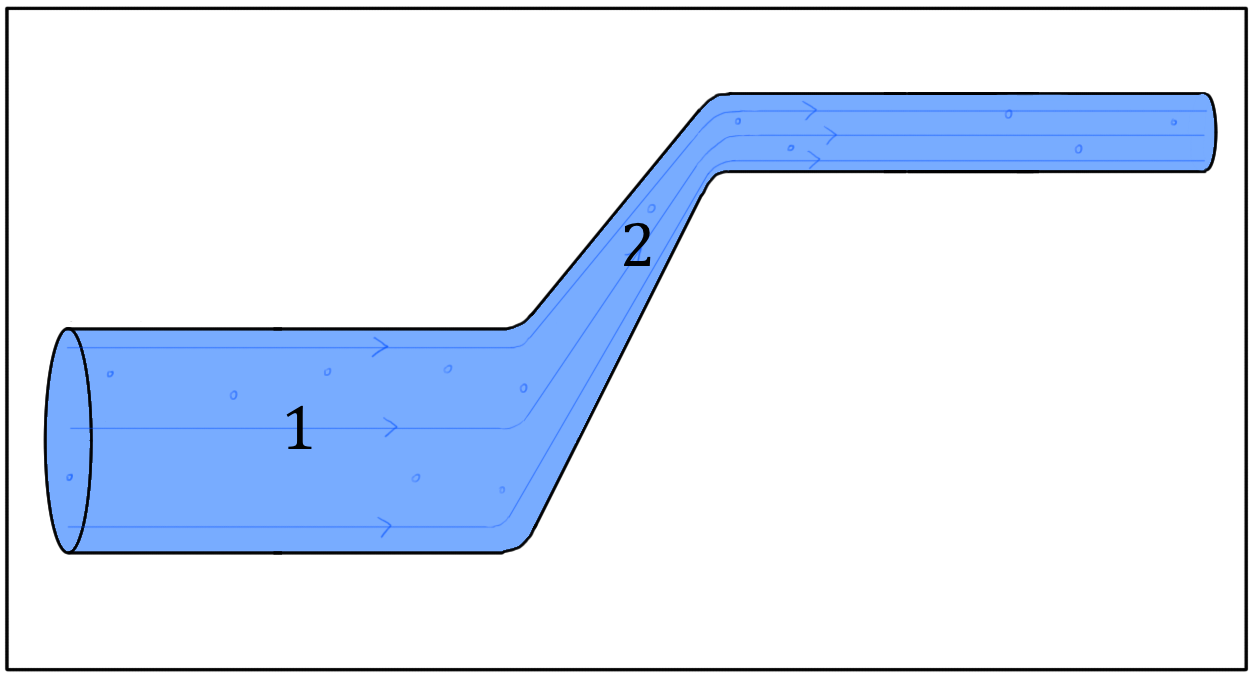
Fluids can flow steadily, or be turbulent. In steady flow, the fluid passing a given point maintains a steady velocity. For turbulent flow, the speed and or the direction of the flow varies. In steady flow, the motion can be represented with streamlines showing the direction the water flows in different areas. The density of the streamlines increases as the velocity increases.
Fluids can be compressible or incompressible. This is the big difference between liquids and gases, because liquids are generally incompressible, meaning that they don't change volume much in response to a pressure change; gases are compressible, and will change volume in response to a change in pressure.
Fluid can be viscous (pours slowly) or non-viscous (pours easily).
Fluid flow can be rotational or irrotational. Irrotational means it travels in straight lines; rotational means it swirls.
We'll focus on irrotational, incompressible, steady streamline non-viscous flow on which the equation is derived at.
Bernoulli's equation is essentially a more general and mathematical form of Bernoulli's principle that also takes into account changes in gravitational potential energy. Let's take a look at Bernoulli's equation and get a feel for what it says and how one would go about using it. Bernoulli's equation relates the pressure, speed, and height of any two points (1 and 2) in a steady streamline flowing fluid of density rho. Bernoulli's equation is usually written as follows,
P, start subscript, 1, end subscript, plus, start fraction, 1, divided by, 2, end fraction, rho, v, start subscript, 1, end subscript, start superscript, 2, end superscript, plus, rho, g, h, start subscript, 1, end subscript, equals, P, start subscript, 2, end subscript, plus, start fraction, 1, divided by, 2, end fraction, rho, v, start subscript, 2, end subscript, start superscript, 2, end superscript, plus, rho, g, h, start subscript, 2, end subscript
The variables P, start subscript, 1, end subscriptv, start subscript, 1, end subscripth, start subscript, 1, end subscript refer to the pressure, speed, and height of the fluid at point 1, whereas the variables P, start subscript, 2, end subscriptv, start subscript, 2, end subscript, and h, start subscript, 2, end subscript refer to the pressure, speed, and height of the fluid at point 2 as seen in the diagram below. The diagram below shows one particular choice of two points (1 and 2) in the fluid, but Bernoulli's equation will hold for any two points in the fluid.
Bernoulli's equation can be viewed as a conservation of energy law for a flowing fluid. We saw that Bernoulli's equation was the result of using the fact that any extra kinetic or potential energy gained by a system of fluid is caused by work done from external pressure surrounding the fluid. You should keep in mind that we had to make many assumptions along the way for this derivation to work. We had to assume streamline flow and no dissipative forces, since otherwise there would have been thermal energy generated. We had to assume steady flow, since otherwise our trick of canceling the energies of the middle section would not have worked. We had to assume incompressibility, since otherwise the volumes and masses would not necessarily be equal. We have already mentioned itearlier before going to this equation.
Since the quantity P, plus, start fraction, 1, divided by, 2, end fraction, rho, v, start superscript, 2, end superscript, plus, rho, g, h is the same at every point in a streamline, another way to write Bernoulli's equation is,
P, plus, start fraction, 1, divided by, 2, end fraction, rho, v, start superscript, 2, end superscript, plus, rho, g, h, equals, c, o, n, s, t, a, n, t
This constant will be different for different fluid systems, but for a given steady state streamline non-dissipative flowing fluid, the value of P, plus, start fraction, 1, divided by, 2, end fraction, rho, v, start superscript, 2, end superscript, plus, rho, g, h will be the same at any point along the flowing fluid.
Bernoulli's principle can be applied to various types of fluid flow, resulting in various forms of Bernoulli's equation, there are different forms of Bernoulli's equation for different types of fluids. 
The metal that flows through runner, sub runner & gate obeys the Bernoulli's equation which states that total energy head remains constant. While design the runner & gate we should keep in mind that

  1. To minimize turbulence to avoid trapping of gas in cavity.
  2. To get enough metal in the die before the solidification starts
  3.  To avoid shrinkage
  4. Incorporate a system to avoid trapping of nonmetallic substances in casting.
So friends next time please make sure your runner & gate is designed in optimum condition in line with Bernoulli's equation.