High pressure die casting is all about how best you feed the metal in the die cavity. we have molten metal & the die casting machine which is used to push the metal with high pressure & high velocity inside the cavity. The metal starts moving from the sleeve to main runner & then to sub runner & finally enter the die cavity through gate. Therefore we can understand that gate & runners are critical for quality casting, because this actually controls the flow of metal inside the cavity.
Before going to the design aspects of runner & gate in high pressure die casting, we have to understand how liquid metal behaves when it is pushed through the runner & gate with high pressure & high velocity. If we mastermind the property of fluid mechanics, it will be easy for us to arrive at a proper runner & gate design in die casting.
To understand the property of fluid we will go through the "Bernoulli Equation".
Fluid dynamics is the study of how fluids behave when they're in motion. This can get very complicated, so we'll focus on one simple case by Bernoulli's equation, but we should briefly understand the different categories of fluid flow.
Fluids can flow steadily, or be turbulent. In steady flow, the fluid passing a given point maintains a steady velocity. For turbulent flow, the speed and or the direction of the flow varies. In steady flow, the motion can be represented with streamlines showing the direction the water flows in different areas. The density of the streamlines increases as the velocity increases.
Fluids can be compressible or incompressible. This is the big difference between liquids and gases, because liquids are generally incompressible, meaning that they don't change volume much in response to a pressure change; gases are compressible, and will change volume in response to a change in pressure.
Fluid can be viscous (pours slowly) or non-viscous (pours easily).
Fluid flow can be rotational or irrotational. Irrotational means it travels in straight lines; rotational means it swirls.
We'll focus on irrotational, incompressible, steady streamline non-viscous flow on which the equation is derived at.
 Bernoulli's equation can be viewed as a conservation of energy law for a flowing fluid. We saw that Bernoulli's equation was the result of using the fact that any extra kinetic or potential energy gained by a system of fluid is caused by work done from external pressure surrounding the fluid. You should keep in mind that we had to make many assumptions along the way for this derivation to work. We had to assume streamline flow and no dissipative forces, since otherwise there would have been thermal energy generated. We had to assume steady flow, since otherwise our trick of canceling the energies of the middle section would not have worked. We had to assume incompressibility, since otherwise the volumes and masses would not necessarily be equal. We have already mentioned itearlier before going to this equation.
The metal that flows through runner, sub runner & gate obeys the Bernoulli's equation which states that total energy head remains constant. While design the runner & gate we should keep in mind that
Before going to the design aspects of runner & gate in high pressure die casting, we have to understand how liquid metal behaves when it is pushed through the runner & gate with high pressure & high velocity. If we mastermind the property of fluid mechanics, it will be easy for us to arrive at a proper runner & gate design in die casting.
To understand the property of fluid we will go through the "Bernoulli Equation".
Fluid dynamics is the study of how fluids behave when they're in motion. This can get very complicated, so we'll focus on one simple case by Bernoulli's equation, but we should briefly understand the different categories of fluid flow.
Fluids can flow steadily, or be turbulent. In steady flow, the fluid passing a given point maintains a steady velocity. For turbulent flow, the speed and or the direction of the flow varies. In steady flow, the motion can be represented with streamlines showing the direction the water flows in different areas. The density of the streamlines increases as the velocity increases.
Fluids can be compressible or incompressible. This is the big difference between liquids and gases, because liquids are generally incompressible, meaning that they don't change volume much in response to a pressure change; gases are compressible, and will change volume in response to a change in pressure.
Fluid can be viscous (pours slowly) or non-viscous (pours easily).
Fluid flow can be rotational or irrotational. Irrotational means it travels in straight lines; rotational means it swirls.
We'll focus on irrotational, incompressible, steady streamline non-viscous flow on which the equation is derived at.
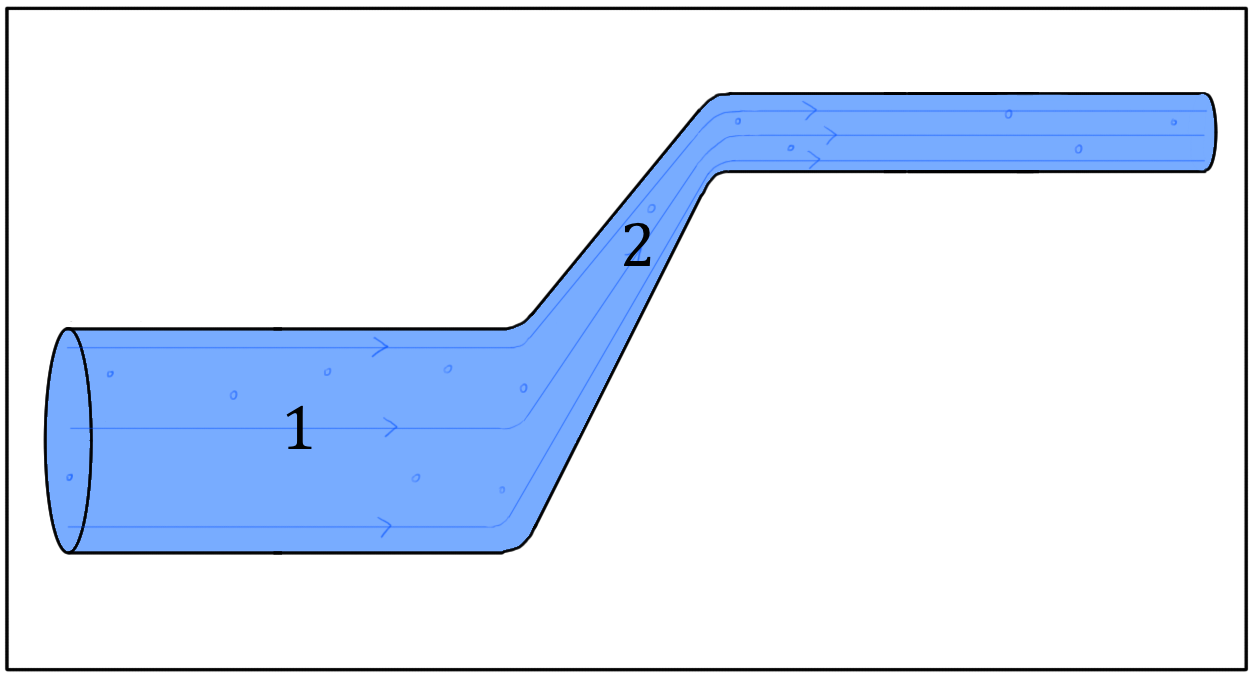
Bernoulli's equation is essentially a more general and mathematical form of Bernoulli's principle that also takes into account changes in gravitational potential energy. Let's take a look at Bernoulli's equation and get a feel for what it says and how one would go about using it. Bernoulli's equation relates the pressure, speed, and height of any two points (1 and 2) in a steady streamline flowing fluid of density . Bernoulli's equation is usually written as follows,
The variables , , refer to the pressure, speed, and height of the fluid at point 1, whereas the variables , , and refer to the pressure, speed, and height of the fluid at point 2 as seen in the diagram below. The diagram below shows one particular choice of two points (1 and 2) in the fluid, but Bernoulli's equation will hold for any two points in the fluid.
Since the quantity is the same at every point in a streamline, another way to write Bernoulli's equation is,
This constant will be different for different fluid systems, but for a given steady state streamline non-dissipative flowing fluid, the value of will be the same at any point along the flowing fluid.
Bernoulli's principle can be applied to various types of fluid flow, resulting in various forms of Bernoulli's equation, there are different forms of Bernoulli's equation for different types of fluids.
- To minimize turbulence to avoid trapping of gas in cavity.
- To get enough metal in the die before the solidification starts
- To avoid shrinkage
- Incorporate a system to avoid trapping of nonmetallic substances in casting.
So friends next time please make sure your runner & gate is designed in optimum condition in line with Bernoulli's equation.

With the passage of time alloy die casting is improving with the advancements of industry
ReplyDelete